
One Year Later: Who Is Actually Benefiting From The One Big Beautiful Bill?

It has been nearly one year since the One Big Beautiful Bill Act (OBBBA) was signed into law. We are happy to report that it has created real opportunities, but how much it matters for you depends on your situation.
If we've been doing tax planning work together, there's a good chance we've already talked through how this affects you, and in many cases, you've already seen the benefit on your return. If we've been filing your taxes but haven't had a deeper planning conversation, you may be curious about whether there's more to do.
Keep in mind: capturing the greatest benefit under this law requires action before December 31. After that, the window closes.
Here’s who’s actually benefiting:
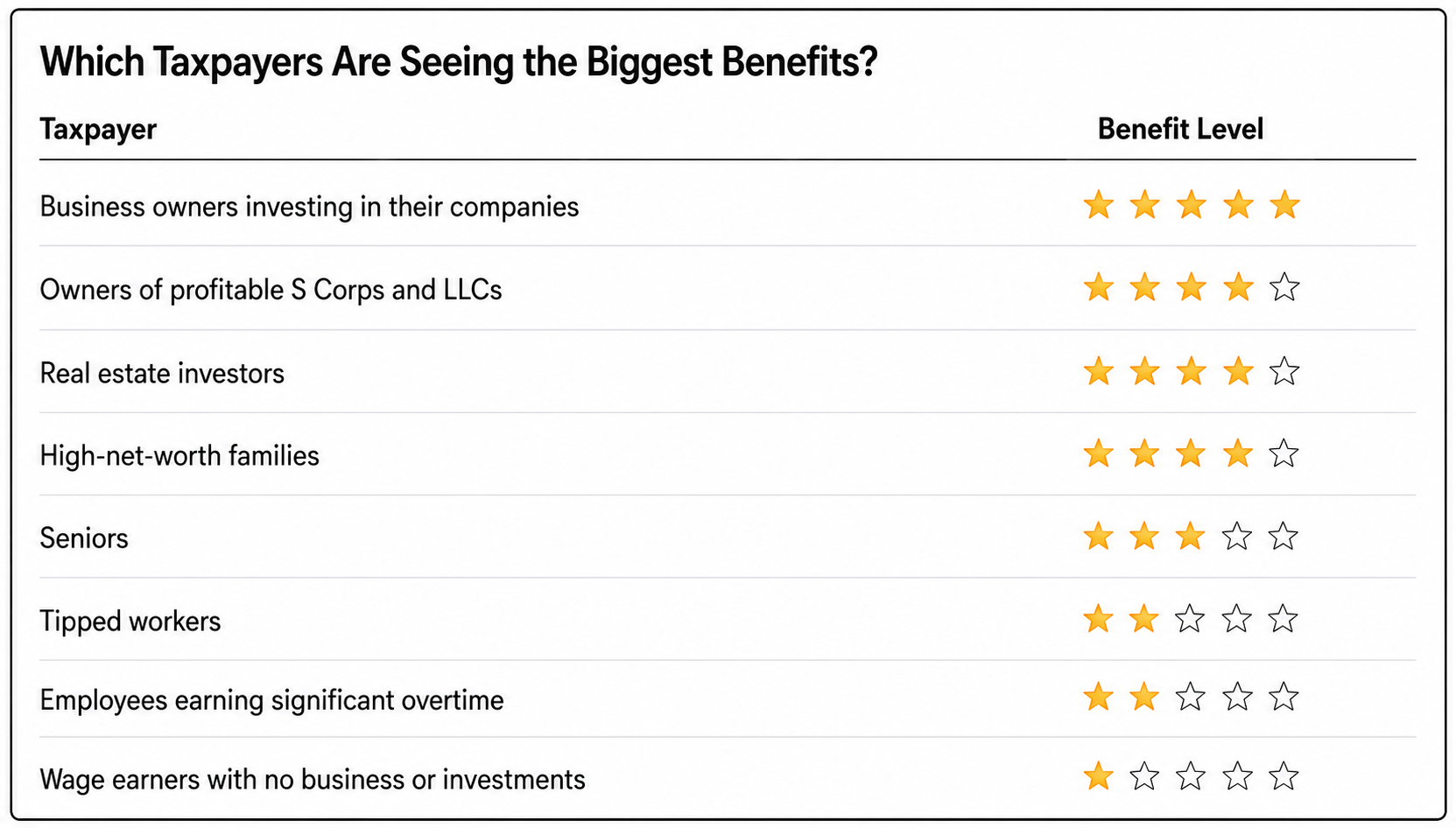
These ratings reflect the relative scope of benefit available under the OBBBA based on income level, business structure, and planning opportunity.
As an RBA client, you more than likely fall in the first 5 groups of the chart above.
Your benefit is based on your income level, industry, and the types of investments you have. We are reviewing your income, entity structure, deductions, investments, retirement distributions, and year-end planning opportunities to see where these rules may reduce your total tax bill.
If you’re a business owner or investor, your benefit may include the following:
20% QBI Deduction - Owners of S Corporations, LLCs, partnerships, and sole proprietorships with profitable pass-through businesses.
Higher-income owners may face limitations based on taxable income, filing status, W-2 wages, business type, and other factors. This is where planning can help determine whether you can qualify for, preserve, or maximize this deduction.
One important item to review before Q4 is your salary-to-distribution ratio. The right salary-to-distribution ratio depends on your income level — this is something we review with you.
100% Bonus Depreciation & Expanded Section 179 - Businesses purchasing equipment, machinery, technology, vehicles, and qualifying improvements.
This is most valuable for profitable businesses planning to spend $50,000+ on business assets; Section 179 limits were increased to benefit larger companies.
If you're planning to spend $50,000+ on business assets this year, it is important to evaluate your equipment purchases now. Each asset needs to qualify and be properly placed in service, so waiting until December can limit your options.
Higher SALT Deduction - Taxpayers in high-tax states (CA, NY, NJ, CT, IL). The SALT cap increased to $40,000 for many itemizing taxpayers, but the benefit begins to phase down for taxpayers with modified adjusted gross income over $500,000, or $250,000 for married filing separately.
The key is to use tax-incentivized deductions to reduce your taxable income while keeping cash in your pocket. In some cases, the pass-through entity tax election may still be one of the best options for deducting state income taxes paid through the business.
If you’re a senior, high-net-worth individual, or high-net-worth family, here’s how this tax law may affect you:
High-Net-Worth Families Earning W-2 Income: You are caught in the middle of the tax law. Your benefit is limited by your W-2 income. One potential way to reduce your tax liability is through strategic investment planning tailored to your income, deductions, credits, and long-term financial goals.
If you are in this group, this is your leverage point on your total tax bill. Your total tax bill is the total amount you pay to the IRS for the year through withholding, estimated payments, and any balance due when you file — not just the amount owed with your return. In some cases, taxpayers with larger federal tax liabilities may be able to explore tax credit strategies, including certain transferable credits. These require careful due diligence, documentation, and advisor review before moving forward.
Creating passive income through other investments or shifting income toward long-term capital gains, which are taxed at lower rates, can also reduce your overall bill.
Senior Deduction - We love this deduction for our senior clients. If you are retired and living on retirement income, IRA or 401(k) distributions, pension income, capital gains, or trust income, it is important to work with your financial and tax advisors.
For 2025 through 2028, taxpayers age 65 and older may qualify for an additional $6,000 deduction per eligible individual. A married couple may qualify for up to $12,000 if both spouses are 65 or older. This deduction phases out when modified adjusted gross income exceeds $75,000 for single filers or $150,000 for married filing jointly.
You may still receive a partial deduction above these thresholds and there are some strategies that may bring your income back within range. Options include, but are not limited to:
Gifting
Revisiting Roth Conversions
Balancing distributions from portfolios with taxable and non-taxable income
Estate & Gift Tax Exemption - Can benefit all groups depending on the value of your assets. You have a lifetime exclusion, so gifts over the annual exclusion amount may not result in tax due, but they may require a gift tax return and proper documentation.
If your family has significant assets (>$5M) or is planning wealth transfers, consider having a wealth transfer conversation.
Your Second-Half Planning Checklist
At RBA Tax Advisors, our goal is not just to prepare accurate tax returns. Our goal is to help you make informed decisions before the year ends, while planning opportunities are still available.
Below is a list of some things we are currently reviewing. If any of the following apply to your situation, it may be worth having a conversation now, especially if you have not yet scheduled your intake assessment meeting:
Major business purchases planned this year
S-corp salary vs. distribution balance
QBI deduction eligibility review
PTE tax election (high-tax states)
Real estate depreciation or cost segregation
Retirement contribution maximization
Charitable giving strategies
Estate or gifting plan review
Estimated tax payment adjustments
Business entity structure review
If you have changes to report or questions about your situation, please email us at support@rbataxadvisors.com with the subject line “Second-Half Tax Planning Review.” The earlier we review your income, business activity, investments, deductions, and year-end plans, the more options we may have before December 31.
Best regards,
RBA Tax Advisors
